
If you've ever wondered whether your breathing, sleep, jaw, and oral health are connected, they are. Airway dentistry looks beyond individual teeth to understand how the mouth, tongue, jaw, and airway work together, and how problems with that system can affect everything from sleep quality and energy levels to childhood development and long-term health.
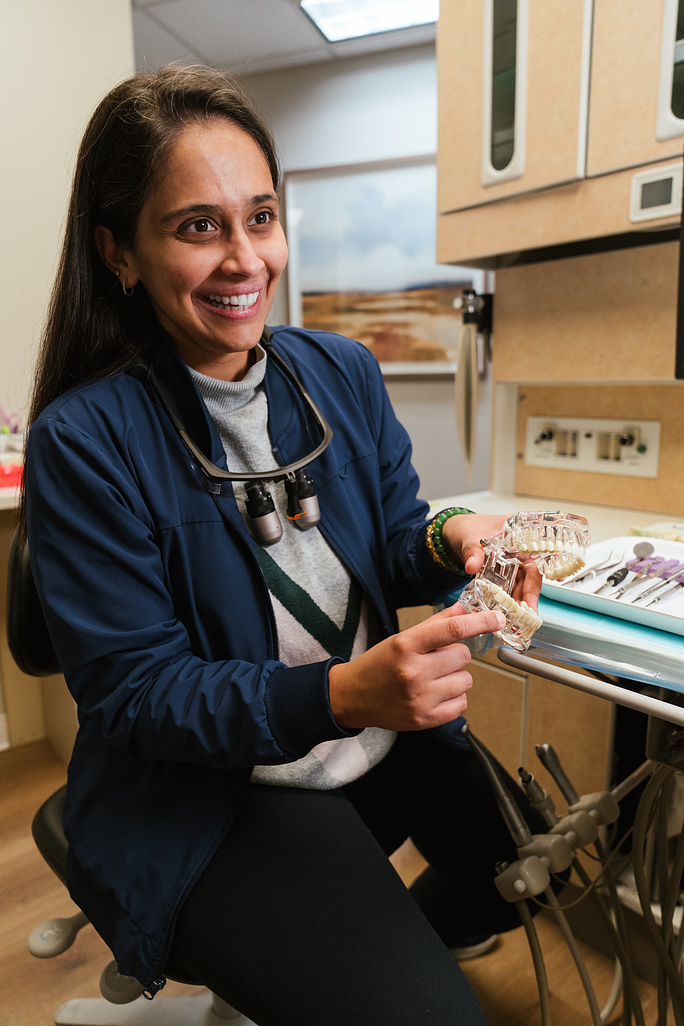
At SOMA Integrative Dentistry in Greensboro, Dr. Priyanka Dand takes a whole-body approach to dental care, helping patients uncover the root causes behind concerns that often go unnoticed. Inspired by her own daughter's experience with an undiagnosed tongue tie, she built her practice around understanding how airway health influences overall wellness.
Continue reading to learn how airway dentistry works, the signs of airway dysfunction in children and adults, and the treatment options that can help you or your family breathe, sleep, and feel better.
What separates airway dentistry from a conventional approach is the question being asked. Instead of "what needs fixing today," we ask "why is this happening, and what does it mean long term." Conventional dentistry tends to treat what's in front of it. An airway focus pulls back to look at the underlying cause.
Most people think of the dentist as the place to clean teeth or fix a cavity. But your mouth is the gateway to your airway, breathing, and sleep. When something in that system is off, whether a narrow palate, a restricted tongue, or a jaw that didn't grow to full width, it can quietly drive problems far from your mouth: poor sleep, fatigue, trouble concentrating, even strain on the heart. This is part of what makes our approach unique.
If you've been told your symptoms are just stress or aging, there may be an airway piece no one has examined. Naming that is often the first relief patients feel. When you're ready, we'd love to connect with you and listen to your full story.
The palate, the roof of your mouth, is also the floor of your nasal cavity. When the jaw grows to full size and the tongue rests gently against the roof of the mouth, that light pressure helps widen the palate over time. A wider palate means more room for air to move through the nose. Nasal breathing with the tongue in its proper place helps shape the face and airway from the inside out. This is the foundation of airway dentistry in Greensboro, NC.
When that process is disrupted, things shift. A narrow palate, an underdeveloped jaw, or a tongue that sits low can shrink the space for airflow. The airway gets smaller, and the body works harder to pull air through, especially at night when muscles relax.
Several things influence how the jaw and airway develop together:
These show up in real ways: in how a child's face grows, in how a teenager sleeps, in how an adult feels at 6 a.m. The jaw and airway are tied to posture, the nervous system, energy, focus, and mood. Addressing these patterns early is part of why myofunctional therapy in Greensboro, NC can support healthy development.
When structural patterns carry into adulthood, they often surface as sleep problems people don't connect to their airway. Snoring is often the body signaling that breathing during sleep is harder than it should be, and it sits at one end of a wide spectrum.
That spectrum runs from upper airway resistance syndrome, where the airway narrows enough to fragment sleep without full breathing pauses, to obstructive sleep apnea, where the airway repeatedly collapses through the night. The symptoms rarely look like a breathing problem. They look like ordinary life:
These aren't minor. Over time, fragmented sleep affects cardiovascular health, the immune system, metabolism, and mental wellbeing. The body does its most important repair work at night, and if breathing interrupts it, that work doesn't happen as it should.
Here's where dentistry surprises people. Jaw size and position, tongue posture, palate development, and muscle tone around the throat all influence how open the airway stays during sleep. A dentist practicing airway dentistry can look at the whole picture, spot signs worth investigating, and point you toward the right next step. For some patients, that path includes supportive options like myofunctional therapy to retrain tongue posture and muscle tone. We don't replace your physician or sleep specialist; we notice what the mouth is telling us and co-manage alongside your care team. If you're wondering whether your sleep is connected to your airway, reach out to our Greensboro team and we'll help you understand your next step.
For many people the story starts during the day with mouth breathing, one of the most overlooked contributors to airway trouble.
Most treat it as a minor annoyance: a dry throat, chapped lips. As a chronic pattern, the effects run deeper. The body was built to breathe through the nose, where air is filtered, warmed, and humidified. Bypass that day after day and the consequences accumulate:
If you've noticed chronically chapped lips, a child with a narrow face or open mouth at rest, or teeth that crowd even after orthodontics, mouth breathing could be part of the picture. It's usually a symptom, not the root problem, often signaling that something upstream isn't working: a structural issue, tongue tie, enlarged tonsils, or a blocked nose. Treating the habit without finding the cause is a bandage. The useful question is always why it's happening.
This is where an airway-focused approach makes the difference, looking at the whole person rather than the teeth alone. For many patients, myofunctional therapy helps retrain breathing and tongue posture once the underlying cause has been identified. If any of this sounds familiar for you or your child, we're here to listen and help you understand what's happening.
Where the tongue rests and how freely it moves can matter as much as anything visible from outside. The tongue is a powerful muscle, and its resting position shapes more than people realize.
Resting correctly, the tongue sits gently against the roof of the mouth. That same light pressure that helps guide palate width and natural airway space, as we covered earlier. When something restricts its range of motion, like a tongue tie (ankyloglossia), that posture is compromised. The tongue drops low, the jaw narrows, and the airway can crowd. In children this influences facial growth; in adults it can feed snoring, disrupted sleep, and trouble breathing through the nose.
Tongue ties don't all look alike. Some are obvious, others tucked beneath the surface and easy to miss without a careful exam. Their effects can show up as:
Releasing a tongue tie is only part of the picture. Without retraining how the tongue moves and rests, old habits creep back. That's where myofunctional therapy comes in: a targeted way of retraining the muscles of the tongue, lips, and face so the body can use the freedom a release creates. Done well, structural release and functional retraining happen together, which is why this work usually involves a myofunctional therapist as a partner. It's all part of the airway-focused care we provide as a family in Greensboro.
A child's airway is still growing, which means the window to gently guide that growth is open, and it won't stay open forever. Catching structural concerns early isn't about alarm. It's about giving a child the healthiest start while their face and jaw are still taking shape.
Mouth breathing is one of the most common early signals. When a child breathes through the mouth, it changes how the face and jaw develop, the tongue rests low, the palate narrows, and the airway tightens, making nasal breathing harder. It becomes a loop that feeds itself. This is exactly the kind of pattern our airway dentistry approach is designed to catch and address early.
Parents often notice other clues before connecting them to breathing:
None of these guarantees an airway issue, but together they're worth a closer look. A child who isn't sleeping well isn't getting the deep, restorative rest a growing brain and body need, which can show up in mood, learning, and growth. Sometimes a restricted tongue tie or weak oral muscle habits are part of the picture, which is where supportive options like myofunctional therapy can help. Evaluating early lets us see the whole picture, jaw development, tongue posture, and breathing patterns together, while there are more options and gentler approaches that work with a child's natural growth. If you've noticed any of these signs, a proactive evaluation is one of the kindest things you can do.
A good airway assessment is broader than a routine checkup, and it almost never rests on one person's read alone.
Beyond checking for cavities, an airway-aware exam reviews jaw width and development, the height and shape of the palate, where the tongue rests, signs of grinding, the tone of soft tissues at the back of the throat, and how the bite comes together. We also ask about your sleep, energy, breathing habits, and history, because symptoms and structure tell the story together.
Dental X-rays and other imaging show the bony structures and space available in the airway. Screening questionnaires help flag the likelihood of sleep-disordered breathing and whether a referral is warranted. For children, support like myofunctional therapy or treatment for tongue ties may become part of the conversation once the full picture is clear.
A dentist does not diagnose sleep apnea. That's a medical diagnosis, typically requiring a sleep study ordered or interpreted by a sleep physician, in a lab or with a home test. For children, an ENT may evaluate tonsils, adenoids, and nasal airway, and physicians stay in the loop on the bigger picture. The dental and medical sides hand off to one another so the full picture comes into focus.
There's no single fix, and an honest survey includes options a given practice may not offer. What's right depends on the person, age, severity, and what's driving the problem.
Custom devices, often called mandibular advancement devices, gently reposition the lower jaw and tongue during sleep to open the airway. They suit people with primary snoring or mild-to-moderate sleep apnea, those who can't tolerate CPAP, and anyone wanting something portable. An appliance is never a substitute for a proper sleep diagnosis. Our airway dentistry in Greensboro begins with a thorough assessment before any device is recommended.
The continuous positive airway pressure machine remains the gold standard for moderate-to-severe obstructive sleep apnea, keeping the airway open with a steady stream of air through a mask. Highly effective when used consistently, though some find it hard to tolerate.
Muscle retraining that helps the tongue, lips, and face hold proper rest posture, often paired with other treatments (see our myofunctional therapy page for the fuller picture).
A release of restrictive tissue under the tongue or lip to restore range of motion, typically paired with myofunctional therapy. Learn more about our approach to tongue tie treatment in Greensboro.
In children especially, gently widening a narrow palate creates more room for the tongue and nasal airflow, working with natural growth.
Braces or clear aligners address crowding and bite, and when planned with the airway in mind, can support better breathing rather than simply straightening teeth.
For some, the obstruction is in the nose or throat, enlarged tonsils or adenoids, a deviated septum, nasal blockage. An ENT may recommend medical or surgical treatment no dental appliance can replace.
Weight, sleep position, allergies, nasal hygiene, and alcohol near bedtime all influence breathing during sleep. They rarely solve a structural problem alone, but matter as part of a complete plan.
The point is to match the approach to the cause, often combining a few, and to coordinate with the right specialists so you get the right treatment rather than just a convenient one.
Parents weighing care for a child often run into two philosophies. Traditional orthodontics generally waits until most permanent teeth are in, then uses braces or aligners to straighten teeth and correct the bite. It's well established and effective at alignment.
Guided growth and development takes a different starting point. Rather than waiting and then straightening, it aims to influence how the jaws and face grow while a child is still developing, encouraging the upper jaw to reach its full width, supporting nasal breathing and proper tongue posture, and creating room for teeth. The goal isn't only straight teeth; it's a more open airway and a face that develops to its full potential.
Neither approach is automatically right for every child. The difference is one of timing and intent: guided growth works earlier with the airway as a central goal, while traditional orthodontics works later and centers on alignment. Many children benefit from elements of both. What matters is that the philosophy fits your child's situation and that you understand the reasoning.
Your mouth holds more clues about your breathing than most realize. Long before a sleep study or diagnosis, the teeth and jaw are often already telling the story. A whole-body exam through our airway dentistry approach lets us read familiar dental findings through a wider lens.
Signs in the mouth that can point toward an underlying airway pattern include:
None of these alone proves an airway problem. But when several appear together, they're worth a real conversation. Grinding at night, for instance, is sometimes the body's way of holding the airway open during sleep. A narrow palate can limit nasal breathing. Crowded teeth may reflect developmental patterns set early in life. A thorough exam surfaces these connections in ways a quick checkup misses.
Airway care varies widely depending on what's involved, from a focused evaluation to a coordinated plan spanning a frenectomy, myofunctional therapy, an appliance, or growth guidance. The specifics for your situation get reviewed during your consultation, where we walk through what's recommended before you commit to anything. We hold to full transparency on cost rather than letting insurance dictate care.
A few things shape how to plan:
Whether an insurance plan or membership plan saves you more depends on your situation and how much care you expect; we're glad to map both out so the math is clear.
Whether you're concerned about your child's development, struggling with snoring or sleep apnea, or simply wondering if your breathing could be affecting your health, the first step is understanding what's really going on. An airway evaluation is designed to answer those questions, not pressure you into treatment.
At SOMA Integrative Dentistry, Dr. Priyanka Dand (Dr. D) takes time to understand the whole picture. Your first visit includes a conversation about your health history, symptoms, sleep, breathing, and concerns, followed by a comprehensive evaluation of your airway, jaw, bite, and oral function. If additional care is needed, we'll explain your options clearly and coordinate with other providers, such as sleep physicians, ENTs, or myofunctional therapists, whenever appropriate.
Our goal is simple: help you understand the root cause of your symptoms and create a plan that supports your long-term health. Whether that plan includes treatment with us or another specialist, you'll leave with clear answers and a better understanding of your options.
If you're ready to learn more, we'd love to meet you. Call SOMA Integrative Dentistry at (336) 288-4499or contact our Greensboro office to schedule your airway consultation.