
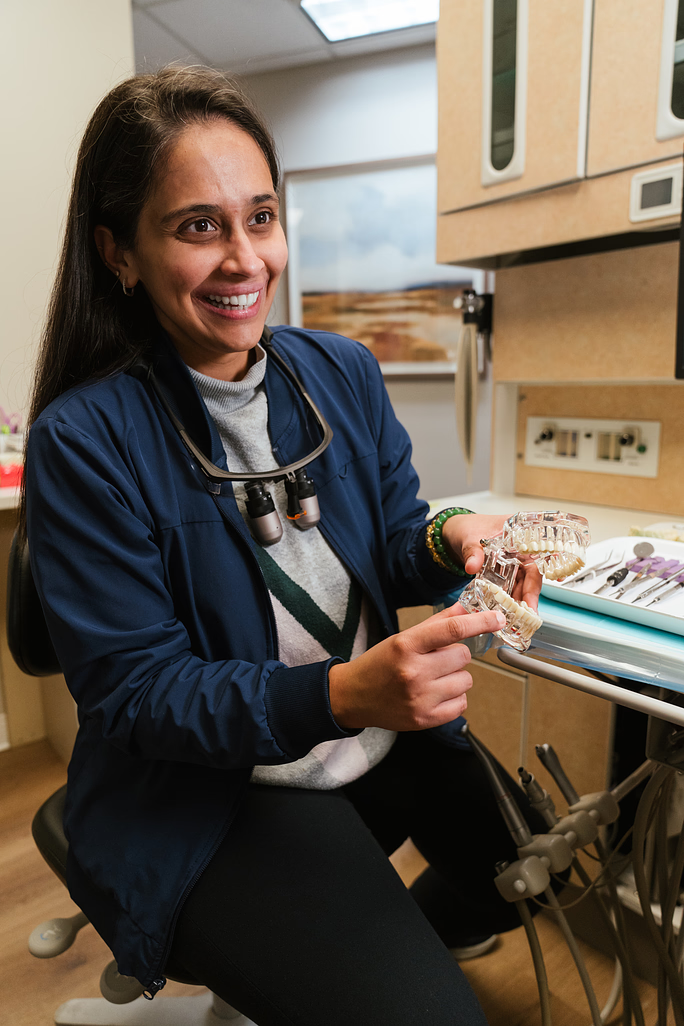
Wholistic dentistry, also called integrative or biological dentistry, looks at oral health as part of your overall health rather than treating your teeth and gums as completely separate from the rest of your body.
Your oral health can intersect with areas such as sleep, breathing, nutrition, jaw development, and systemic health. An integrative approach considers those connections alongside the fundamentals of preventive, restorative, and general dental care.
At SOMA Integrative Dentistry in Greensboro, NC, Dr. Dand, Dr. Kakadia and our team take this broader perspective when evaluating your oral health. This guide explains what wholistic dentistry means, how it differs from conventional dental care, what treatments may be involved, and what to consider when deciding whether an integrative approach is right for you.
Wholistic dentistry is an approach to dental care that considers the relationship between your oral health and the rest of your body.
You may also hear terms such as integrative dentistry, biological dentistry, or whole-body dentistry. These terms aren't used identically by every practice, but they generally describe an approach that looks beyond an isolated dental problem and considers additional factors that may influence oral health.
For example, someone experiencing significant tooth wear may have more going on than simply damaged enamel. Clenching or grinding, bite forces, sleep-related concerns, stress, or jaw function may all be worth discussing as part of the evaluation.
Similarly, recurring gum inflammation may lead to questions about oral hygiene, nutrition, blood sugar management, medications, smoking, and other factors that can influence periodontal health.
The goal isn't to replace evidence-based dental treatment. Rather, an integrative approach adds context to the clinical picture so we can better understand the factors that may be contributing to a person's oral health.
At SOMA Integrative Dentistry, we combine this broader perspective with modern dental technology and conventional preventive and restorative care.
One of the most common questions about wholistic dentistry is how it actually differs from conventional dental care.
The answer isn't that one approach treats teeth while the other doesn't. Both types of practices can provide examinations, cleanings, fillings, crowns, periodontal care, and other routine dental services.
The difference is generally how broadly the provider evaluates the factors surrounding your oral health.
An integrative dental practice may consider:
That doesn't mean every one of these factors is relevant to every person. A good evaluation should be individualized rather than assuming that one explanation applies to everyone.
It's also worth noting that the term "wholistic dentist" isn't a standardized specialty designation in the same way as recognized dental specialties. If you're considering an integrative practice, look at the dentist's education, training, technology, treatment philosophy, and approach to collaboration rather than relying on the label alone.
Your mouth is part of your body, so it's not surprising that oral health can intersect with broader health.
Some of these relationships are well established. For example, periodontal disease involves inflammation and infection of the tissues supporting the teeth, and people with diabetes may have a higher risk of developing or experiencing complications from periodontal disease. At the same time, treating periodontal disease can be an important part of managing oral health in people with diabetes.
There are also established connections between oral health and cardiovascular health, although the relationship is complex and shouldn't be interpreted to mean that gum disease directly causes heart disease.
Other connections worth considering include:
The mouth-body connection doesn't mean every symptom has an oral cause. It means oral health deserves to be considered as part of the larger picture.
Airway health is an important part of integrative dentistry, particularly when someone has symptoms that may be associated with sleep-disordered breathing.
The jaw, tongue, palate, and surrounding soft tissues all contribute to the anatomy of the upper airway. Certain structural or functional characteristics may be associated with breathing difficulties during sleep.
Some signs that may warrant an airway discussion include:
These symptoms don't necessarily mean someone has an airway disorder or sleep apnea. A proper diagnosis may require evaluation by a physician or sleep specialist and, in some cases, a sleep study.
An airway-focused dental evaluation can be one part of that process. At SOMA Integrative Dentistry, we may evaluate oral and facial structures, jaw position, tongue function, and other factors that could be relevant to breathing.
When appropriate, we can also coordinate care with other professionals.
Children's oral and facial structures are constantly developing. That makes growth and development an important part of an integrative approach to pediatric dental care.
Rather than waiting until dental crowding or other concerns become more pronounced, an early evaluation can help identify factors that may be affecting development.
We may look at:
This doesn't mean every child needs treatment. In many cases, monitoring growth and development may be the most appropriate approach.
For children with specific concerns, treatment could include coordination with an orthodontist, myofunctional therapist, speech-language pathologist, ENT, or other professional.
A tongue tie occurs when the tissue beneath the tongue restricts its movement. Depending on the individual, restricted tongue movement may affect feeding, oral function, speech, or tongue posture.
A tongue tie evaluation should look at function rather than simply the appearance of the tissue. If a restriction is clinically significant, treatment may include a frenectomy, along with appropriate follow-up or therapy.
You can learn more about tongue ties and frenectomy at SOMA.
Healthy gums are an important part of overall oral health, and periodontal disease is one area where oral and systemic health clearly intersect.
Gum disease develops through a combination of bacterial plaque, the body's inflammatory response, and individual risk factors. Genetics, smoking, diabetes, oral hygiene, medications, and other factors can all influence periodontal health.
Nutrition is another piece of the picture.
A diet high in frequently consumed sugars and refined carbohydrates can increase the risk of tooth decay. Overall nutrition can also influence general health and the body's ability to maintain healthy tissues.
That doesn't mean nutrition replaces brushing, flossing, professional cleanings, or periodontal treatment. Instead, it can be one component of a more complete approach to oral health.
When gum inflammation keeps returning despite appropriate dental care, it's worth looking at the broader picture rather than assuming that another cleaning alone will solve the problem.
Wholistic dentistry isn't one particular procedure. It can include many of the same treatments found in conventional dental practices, combined with additional evaluation and treatment options based on a person's needs.
At SOMA, our services may include:
Not everyone needs all of these services. The point of an integrative approach is to determine which ones, if any, are appropriate for you.
You can explore the full dental care menu at SOMA.
Technology doesn't make care wholistic by itself, but advanced diagnostics can give us information that isn't available through a traditional visual examination.
For example, CBCT imaging creates a three-dimensional view of the teeth, jaws, facial structures, and other relevant anatomy. When clinically appropriate, that information can help us evaluate areas such as jaw development, airway anatomy, impacted teeth, bone structure, and other concerns.
We don't believe imaging should be performed simply because the technology is available. The decision to use CBCT should be based on whether the additional information is useful for your specific evaluation.
When we do recommend 3D imaging, we'll explain what we're looking for and how the information may affect your care.
An integrative dental appointment should still feel like a dental appointment. You'll receive appropriate examinations, preventive care, diagnostic imaging when needed, and treatment recommendations based on your oral health.
The difference is that the conversation may go beyond your teeth and gums.
Depending on your concerns, we may ask about:
We may also evaluate your bite, jaw function, tongue movement, oral tissues, and facial development.
Not every person needs an extensive airway or whole-body assessment. The evaluation should be guided by your history and concerns.
Most importantly, you should understand what we're seeing and why we're recommending a particular course of action.
There's no single type of person who needs wholistic dentistry.
You might be interested in an integrative approach if:
You don't need to have a complicated health history to benefit from a broader conversation. For many people, it simply means having more context around their dental care and understanding why a particular recommendation makes sense.
This is an important question because "wholistic" can mean very different things depending on the practice.
A whole-body approach doesn't automatically make a treatment evidence-based. When choosing a dentist, it's reasonable to ask what training supports their recommendations, what evidence they use, and how they distinguish established treatments from emerging or complementary approaches.
At SOMA, integrative care is intended to complement modern dentistry rather than reject it. Preventive dentistry, periodontal treatment, restorative care, appropriate diagnostics, and other established dental practices remain foundational.
An integrative approach adds another layer of consideration around factors such as airway health, development, materials, nutrition, and collaboration with other providers.
If a concern requires medical evaluation or treatment outside dentistry, that should be recognized rather than trying to make every problem a dental problem.
Because wholistic dentistry isn't a single standardized specialty, it's worth doing some research before choosing a provider.
Consider asking:
You should feel comfortable asking these questions. A good provider should be able to explain the reasoning behind recommendations without making you feel pressured to pursue treatment.
The cost of wholistic or integrative dentistry varies significantly because it isn't a single treatment.
A routine cleaning and examination will generally be different from a comprehensive airway evaluation, restorative treatment, or tongue tie procedure. The cost also depends on the diagnostics and treatment recommended for your individual situation.
SOMA is a fee-for-service practice and is not in-network with dental insurance. If you have out-of-network benefits, you may still be eligible for reimbursement depending on your plan.
Before beginning recommended treatment, you should receive information about the anticipated costs and what is included.
You can find additional information through the SOMA patient center.
Wholistic dentistry isn't about choosing between "natural" care and modern dentistry. At its best, an integrative approach combines appropriate dental treatment with a broader understanding of the factors that can influence oral health.
That may mean looking more closely at your child's development, discussing your sleep and breathing, considering different restorative materials, addressing periodontal risk factors, or coordinating care with another provider.
It may also simply mean receiving excellent preventive and restorative dentistry from a team that takes the time to understand the person behind the teeth.
At SOMA Integrative Dentistry, Dr. Priyanka Dand, Dr. Rahen Kakadia and our team in Greensboro take that broader perspective while keeping your individual needs at the center of the conversation.
If you'd like to learn more about our approach, explore what makes SOMA unique, or contact our team at (336) 288-4499 to discuss your questions.